Sunday, 3 December 2017

Gold Bullion Coins

A bullion coin is a coin struck from precious metal and kept as a store of value or an investment, rather than used in day-to-day commerce.

Bullion coins are usually available in both gold, silver, platinum and palladium, and are usually multiples or fractions of 1 troy ounce.


Gold Bullion Coins List
Year of Issue
Country
Name
Fineness
1
1967
South Africa
Krugerrand
0.9167
2
1979
Canada
Maple Leaf
0.9999
3
1982
China
Gold Panda
0.9999
4
1986
USA
Gold Eagle
0.9167
5
1986
Australia
Gold Nugget
0.9999
6
1987
UK
Britannia
0.9167
7
1989
Austria
Vienna Philharmonic
0.9999
8
1991
Mexico
Libertad
0.999
9
1995
Poland
Orzel bielik
0.9999
10
1996
Australia
Lunar
0.9999
11
1999
Ukraine
Archangle Michael
0.9999
12
1999
Somalia
Elephant
0.999
13
2001
Malaysia
Kijang Emas
0.9999
14
2009
Kazakhstan
Goldern Irbis
0.9999
15
2010
Israel
Jerusalem of Gold
0.9999
16
2013
UK
Britannia
0.9999
17
2014
UK
Lunar
0.9999
18
2015
India
Indian Gold Coin
0.999
19
2016
UK
Queen's Beasts
0.9999
20
2017
New Zealand
Gold Kiwi
0.9999


South Africa' Kruggerand
Canada's Maple Leaf
China's Gold Panda
Australia's Nugget
USA' Gold Eagle 
Austria's Vienna Philharmonic
Mexico's Libertad
Poland's Orzel bielik
Australia's Lunar
Somalia's Elephant
Ukraine's Archangle Michael
Malaysia's Kijang Emas
Kazakhstan's Golden Irbis
Israel's Jeruselem of Gold
UK's Britannia
UK's Lunar
Indian Gold Coin
Queen's Beasts
New Zealand's Gold Kiwi


Wednesday, 16 August 2017

Malaysia Commemorative Coins 2017 : 29th SEA Games & 9th Asean Para Games


Obverse

The official mascot of the Games named RIMAU is inspired by the graceful and powerful Malayan Tiger. RIMAU stands for Respect, Integrity, Move, Attitude and Unity. The words “BANGKIT BERSAMA” is the theme of the Games which signifies the coming of age for Southeast Asia as a community. The words “SUKAN SEA KE-29” and “SUKAN PARA ASEAN KE-9” is depicted on the upper and lower circumference of the coin. 


Reverse

The words “BANK NEGARA MALAYSIA” as the issuing authority of the commemorative coin is featured on the upper circumference of the coin, while the face value of the coin is inscribed on the lower circumference. The centre of the coin features the official logo of the Games which is the Wau Bulan, while the combination of stripes and shards of colour is collated from the flags of all Southeast Asian countries. 


Wednesday, 25 January 2017

A Brief History of New Zealand Coins


In 1967 New Zealand changed its coinage from the Imperial British standard to the decimal system.  The designs on the coins reflected the wonderful heritage and cultural icons of New Zealand from the last surviving member of an otherwise extinct family of reptiles, the Tuatara, to a representation of a Mäori koruru carved head, which adorns whare or meeting houses.


A number of changes have taken place in the years since decimalisation: the ‘heads’ design featuring the Queen’s portrait was updated in 1986 and again in 1999. The original kiwi 20 cent coin, was replaced with an image of the Pukaki carving in 1990.

When the $1 and $2 notes were taken out of circulation in 1991, they were replaced by the gold-coloured kiwi $1 coin and the $2 coin featuring the kotuku.


In 2006 the 'silver' coins all had a makeover. The ten, twenty and fifty cent coins all become smaller and lighter. The new ten cent coin was also changed to a copper coloured.  The five cent coin was removed from circulation altogether.

Previously made with solid cupro-nickel, the new plated steel coins are not only more cost effective, but also lighter. 

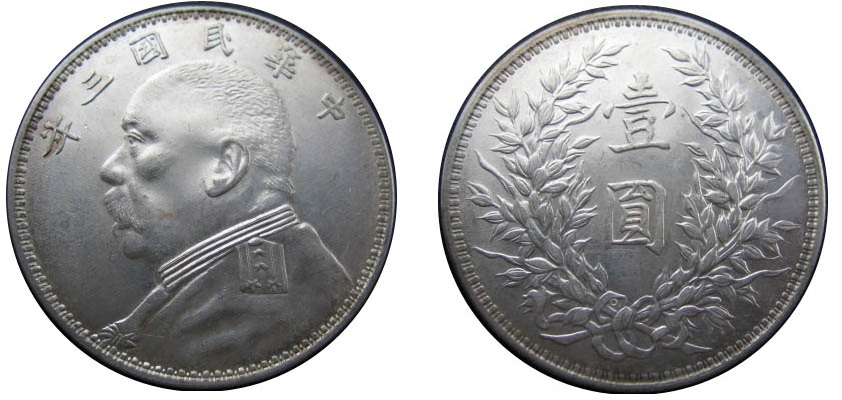
China Trade Dollar 1914-1921 袁头币

钱面:袁仕凯光头侧面像,上环“中华民国三年造”。
钱背:中间汉字“壹元” 周围环嘉禾纹饰。


Technical Specifications
Denomination: 壹圆 1 dollar
Issued by :中華民國 Rebublic of China
Issued Year : 民国三年至十年  1914-1921
Diameter : 39 mm
Weight : 26.4 grams
Coin Shape : Round
Composition : .890 Silver
Engraver : Luigi Giorgi


1911年,辛亥革命成功,清朝覆之。1912年1月,中华民国临时政府在南京成立,孙中山先生就任临时大总统。民国政府将原江南造币厂改为财政部管理,开始铸行 有孙中山先生侧面肖像,面值分为壹圆、贰角、壹角之“中华民国开国纪念币”。民国初年, 中国市场银元流通状况更趋混乱,海外各国银币和清朝龙洋并行,种类繁多,成色不一,市价时高时低,民众经济活动涤受其害。

1914年(民国三年)2月,民国政府着手改革币制,公布“国币条例”及其“实施细侧”。以求整顿并统一银币铸行。规定以壹元银圆为本位币,重七钱二分,成色银九铜一(后改为89%),分壹圆、半圆、贰角、壹角四等币值。十二月,财政部天津造币总厂首铸新版银币,其正面袁世凯侧面头像及发行年号,背面 嘉禾纹饰与币值,俗称“袁头币”。

后南京、广东 、武昌 、甘肃造币分厂陆续开铸,币值有一元 、半元 、二角 、一角等面值。有签字 、无签字版,边齿为185 、170道直线。

纪年有三年 、八年 、九年 、十年四种,细微差异颇多,成色参差不齐。“年”字后没有“造”字,其他年版都在“年”字后面有“造”字。三年版“民”字中有一“点”,而其他年版民字无“点”。

United States Trade Dollar 1873-1885

Descriptions
Obverse : Liberty seated on a pedestal facing the sea to the left holding olive branches surrounded by 13 stars.
Lettering: IN GOD WE TRUST │ LIBERTY


Reverse : An eagle holding branches with berries on them and arrows.
Lettering: UNITED STATES OF AMERICA │E PLURIBUS UNUM │420 GRAINS  .900 FINE │TRADE DOLLAR


Technical Specifications
Denomination: 1 dollar
Issued by : Unites States of America
Year : 1873-1885
Diameter : 38.1 mm
Weight : 27.22 grams
Coin Shape : Round
Composition : .900 Silver
Coin Edge : Reeded
Engraver : William Barber


      x                                                          x                                                               x

The United States trade dollar was a dollar coin minted by the United States Mint to compete with other large silver trade coins that were already popular in East Asia. The idea first came about in the 1860s, when the price of silver began to decline due to increased mining efforts in the western United States. A bill providing in part for the issuance of the trade dollar was eventually put before Congress, where it was approved and later signed into law as the Coinage Act of 1873. The act made trade dollars legal tender up to five dollars. A number of designs were considered for the trade dollar, and an obverse and reverse created by William Barber were selected.

The coins were first struck in 1873, and most of the production was sent to China. Eventually, bullion producers began converting large amounts of silver into trade dollars, causing the coins to make their way into American commercial channels. This caused frustration among those to whom they were given in payment, as the coins were largely maligned and traded for less than one dollar each. In response to their wide distribution in American commerce, the coins were officially demonetized in 1876, but continued to circulate. Production of business strikes ended in 1878, though the mintage of proof coins officially continued until 1883. The trade dollar was re-monetized when the Coinage Act of 1965 was signed into law.


     x                                                          x                                                               x


Year
Mintage
1873
√
1784
√
1875
√
1876
√
1877
√
1878
√
1879
proof, rare
1880
proof, rare
1881
proof, rare
1882
proof, rare
1883
proof, rare
1884
proof, rare
1885
proof, rare

Tuesday, 24 January 2017

New Zealand Coins : Decimal System


Introduction of Decimal Currency

In 1959, a committee was set up to study and report on decimal coinage. This committee was in favour of such an adoption, and after further study, it was announced in 1963 that New Zealand would change to a decimal coinage system.

In 1964, the Decimal Currency Act, 1964 prescribed the designs, diameters, and standard weights of the decimal coins, which first appeared in circulation on 10th July 1967. These coins were all designed by Reginald George James Berry (known as James) of Wellington. His initials (JB) appear on the reverse of all of our then bronze and cupro-nickel coins.

The word Shilling was included on the 10 cent coin to assist with the transition to decimal currency, it featured on minting of the 10c coin for the years 1967, 1968 and 1969 and was dropped in 1970. The 1968 10 cent coin minting were for collectors sets only.


The coins introduced :           
_________________________________________________________________
New Denomination     Old Denomination      Coin Specification
_________________________________________________________________
50 cents                     5 shillings            Alloy: Cupro-nickel
                                 (one Crown)         Diameter: 31.75mm
                                                            Weight: 13.61gm
Design: The barque Endeavour, commanded by Captain Cook, sailing south, with Mt. Taranaki (Egmont) in the distance under the figure "50"

20 cents                     2 shillings            Alloy: Cupro-nickel
   (one Florin)          Diameter: 28.58mm
                              Weight: 11.31gm
Design: Kiwi facing right and fern bush with figure "20"

10 cents                      1 shilling            Alloy: Cupro-nickel
    (one Bob)            Diameter: 23.62mm
                                                            Weight: 5.66gm
Design: A Maori carved head or koruru under the figure "10" with Maori rafter patterns

5 cents                         6 pence             Alloy: Cupro-nickel
                                                            Diameter: 19.43mm
                                                            Weight: 2.83gm
Design: A tuatara curled on a coastal rock on which is superimposed the figure "5". A gull flies in the background

2 cents                         3 pence             Metal: Bronze
                                                            Diameter: 21.08mm
                                                            Weight: 4.14gm
Design: Two kowhai flowers and leaves surrounding the figure "2"

1 cent                          1 penny             Metal: Bronze
                                                            Diameter: 17.53mm
Weight: 2.07gm
Design: A stylised fern leaf enclosing the figure "1"
___________________________________________________________


On the 31st March 1989, the issue of 1 and 2 cent pieces ceased. Both coins were demonetised on the 30th April 1990.


In December 1990, a new 20 cent piece was introduced to replace the old 20 cent piece, as the Kiwi design on the old 20 cent piece was transferred to the new $1 coin. Both designs of the 20 cent coin are legal tender along with the earlier two shilling piece or florin.
__________________________________________________________
20 cents                  Alloy: Cupro-nickel
                              Diameter: 28.58mm
                              Weight: 11.31gm
Design: A representation of a well-known Maori "pukaki" carving.
__________________________________________________________


On the 11th February 1991, new $1 and $2 coins were introduced to replace the $1 and $2 notes. These two coins and above 20 cent coin were all designed by Robert Maurice Conly, M.B.E. of Wellington.

__________________________________________________________
$1                           Alloy: Aluminium-bronze
                               Diameter: 23.0mm
                               Weight: 8.0gm
                               Design: The kiwi, bringing to reality the colloquial 
                               term ‘Kiwi Dollar'.

$2                           Alloy: Aluminium-bronze
                               Diameter: 26.5mm
                               Weight: 10.0gm
 Design: The kotuku (white heron), flying right. The kotuku is one of  New Zealand's rarest birds and is held in particularly high regard in  Maori mythology.
__________________________________________________________


On the 31st July 2006, the Reserve Bank introduced new smaller and lighter 10, 20 and 50 cent coins made of plated steel.  The Bank started withdrawing the corresponding old silver-coloured cupronickel coins at the same time.  The 5 cent coin was withdrawn and not replaced.  The old coin were demonetised, ie declared no longer legal tender, with effect from 1 November 2006.