Showing posts with label 1967. Show all posts

Saturday, 3 February 2018

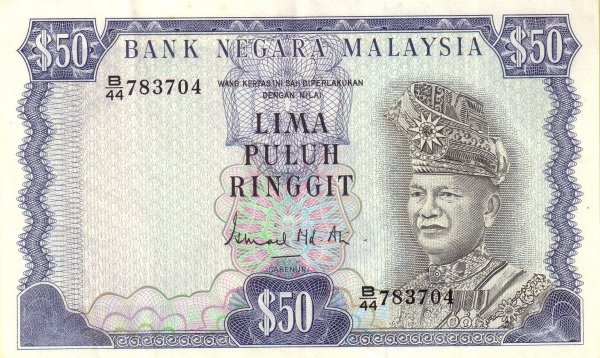
Malaysian Banknotes - 1967 First Series


On 12 June 1967, the Malaysian dollar, issued by the new central bank, Bank Negara Malaysia, replaced the Malaya and British Borneo dollar at par.  The new currency retained all denominations of its predecessor except the $10,000 denomination, and also brought over the colour schemes of the old dollar.

The Malay names ringgit and sen were officially adopted as the sole official names in August 1975.  In 1993, the currency symbol "RM" was introduced to replace the use of the dollar sign "$".
The word ringgit is an obsolete term for "jagged" in Malay and was originally used to refer to the serrated edges of silver Spanish dollars which circulated widely in the area during the 16th and 17th century Portuguese colonial era. In modern usage ringgit is used almost solely for the currency.

Malaysian currency is officially referred to as Ringgit Malaysia, hence the official abbreviation and currency symbol RM.  Internationally, the ISO 4217 currency code for Malaysian ringgit is MYR.


History

1967, 6th June 1a – First banknotes with 2nd BNM's Governor ( Ismail Mohd Ali ) signature: $1, $5, $10, $50, and $100 denominations introduced
1968, 2nd September 1b – $1000 denomination introduced
1972, 16th August 1c – new banknotes with new Malay spelling
1981 1d – new banknotes with 3rd BNM’s Governor ( Abdul Aziz Taha ) signature


First Series 

1a & 1b. 
1967 & 1968 - First Banknotes  )
BNM 2nd Governor - Ismail Mohd Ali


1c. ( 1972 - New Malay spelling )


1d. ( 1981 )
BNM 3rd Governor - Abdul Aziz Taha


Bank Negara Malaysia’s Governors :


Wednesday, 25 January 2017

A Brief History of New Zealand Coins


In 1967 New Zealand changed its coinage from the Imperial British standard to the decimal system.  The designs on the coins reflected the wonderful heritage and cultural icons of New Zealand from the last surviving member of an otherwise extinct family of reptiles, the Tuatara, to a representation of a Mäori koruru carved head, which adorns whare or meeting houses.


A number of changes have taken place in the years since decimalisation: the ‘heads’ design featuring the Queen’s portrait was updated in 1986 and again in 1999. The original kiwi 20 cent coin, was replaced with an image of the Pukaki carving in 1990.

When the $1 and $2 notes were taken out of circulation in 1991, they were replaced by the gold-coloured kiwi $1 coin and the $2 coin featuring the kotuku.


In 2006 the 'silver' coins all had a makeover. The ten, twenty and fifty cent coins all become smaller and lighter. The new ten cent coin was also changed to a copper coloured.  The five cent coin was removed from circulation altogether.

Previously made with solid cupro-nickel, the new plated steel coins are not only more cost effective, but also lighter. 

Tuesday, 24 January 2017

New Zealand Coins : Decimal System


Introduction of Decimal Currency

In 1959, a committee was set up to study and report on decimal coinage. This committee was in favour of such an adoption, and after further study, it was announced in 1963 that New Zealand would change to a decimal coinage system.

In 1964, the Decimal Currency Act, 1964 prescribed the designs, diameters, and standard weights of the decimal coins, which first appeared in circulation on 10th July 1967. These coins were all designed by Reginald George James Berry (known as James) of Wellington. His initials (JB) appear on the reverse of all of our then bronze and cupro-nickel coins.

The word Shilling was included on the 10 cent coin to assist with the transition to decimal currency, it featured on minting of the 10c coin for the years 1967, 1968 and 1969 and was dropped in 1970. The 1968 10 cent coin minting were for collectors sets only.


The coins introduced :           
_________________________________________________________________
New Denomination     Old Denomination      Coin Specification
_________________________________________________________________
50 cents                     5 shillings            Alloy: Cupro-nickel
                                 (one Crown)         Diameter: 31.75mm
                                                            Weight: 13.61gm
Design: The barque Endeavour, commanded by Captain Cook, sailing south, with Mt. Taranaki (Egmont) in the distance under the figure "50"

20 cents                     2 shillings            Alloy: Cupro-nickel
   (one Florin)          Diameter: 28.58mm
                              Weight: 11.31gm
Design: Kiwi facing right and fern bush with figure "20"

10 cents                      1 shilling            Alloy: Cupro-nickel
    (one Bob)            Diameter: 23.62mm
                                                            Weight: 5.66gm
Design: A Maori carved head or koruru under the figure "10" with Maori rafter patterns

5 cents                         6 pence             Alloy: Cupro-nickel
                                                            Diameter: 19.43mm
                                                            Weight: 2.83gm
Design: A tuatara curled on a coastal rock on which is superimposed the figure "5". A gull flies in the background

2 cents                         3 pence             Metal: Bronze
                                                            Diameter: 21.08mm
                                                            Weight: 4.14gm
Design: Two kowhai flowers and leaves surrounding the figure "2"

1 cent                          1 penny             Metal: Bronze
                                                            Diameter: 17.53mm
Weight: 2.07gm
Design: A stylised fern leaf enclosing the figure "1"
___________________________________________________________


On the 31st March 1989, the issue of 1 and 2 cent pieces ceased. Both coins were demonetised on the 30th April 1990.


In December 1990, a new 20 cent piece was introduced to replace the old 20 cent piece, as the Kiwi design on the old 20 cent piece was transferred to the new $1 coin. Both designs of the 20 cent coin are legal tender along with the earlier two shilling piece or florin.
__________________________________________________________
20 cents                  Alloy: Cupro-nickel
                              Diameter: 28.58mm
                              Weight: 11.31gm
Design: A representation of a well-known Maori "pukaki" carving.
__________________________________________________________


On the 11th February 1991, new $1 and $2 coins were introduced to replace the $1 and $2 notes. These two coins and above 20 cent coin were all designed by Robert Maurice Conly, M.B.E. of Wellington.

__________________________________________________________
$1                           Alloy: Aluminium-bronze
                               Diameter: 23.0mm
                               Weight: 8.0gm
                               Design: The kiwi, bringing to reality the colloquial 
                               term ‘Kiwi Dollar'.

$2                           Alloy: Aluminium-bronze
                               Diameter: 26.5mm
                               Weight: 10.0gm
 Design: The kotuku (white heron), flying right. The kotuku is one of  New Zealand's rarest birds and is held in particularly high regard in  Maori mythology.
__________________________________________________________


On the 31st July 2006, the Reserve Bank introduced new smaller and lighter 10, 20 and 50 cent coins made of plated steel.  The Bank started withdrawing the corresponding old silver-coloured cupronickel coins at the same time.  The 5 cent coin was withdrawn and not replaced.  The old coin were demonetised, ie declared no longer legal tender, with effect from 1 November 2006.


Monday, 1 September 2014

Singapore Coins : 1967 First Series


Descriptions
Observe :
1¢ -  A highrise public housing block with a fountain in front and clouds in the background.  
5¢  - A snake-bird ( Anhinga melanogaster ) sitting in its nest and preening its feathers.
10¢ - A seahorse ( Hippocampus coronatus ) with a stylised piece of seaweed.
20¢ - A swordfish ( Xiphias gladius ) against a background symbolising water.
50¢ - A lionfish ( Pterois sp ) from tropical waters.
$1 - A stylised lion ( Panthera leo ) flanked by two stalks of paddy ( Oryza sativa ).
Engraver : Stuart Devlin

Reverse :
In middle is “value” inscripted in numeric and alphabet.  On right outer circle is “year of mint” and ‘SINGAPORE’.  On the left outer circle is 2 stalk of rice.

Egde :
1¢ - smooth.  
5¢, 10¢, 20¢, 50¢ & $1 - reeded


Brief Introduction
Singapore joined Sabah, Sarawak and Malaya to form Malaysia in 1963.  But the union was brief as Singapore exited the federation in 1965 to became an independence state.

Singapore established the Board of Commissioners of Currency Singapore ( BCCS )on 7th April 1967 and issues its own coins and notes.  In 2003, Following the merge of  BCCS with the Monetary Authority of Singapore,  MAS assumed the function of currency issuance in Singapore.

The First Series of circulation coins was issued on 20 November 1967. These coins, displaying various designs, represented a dramatic break from the past, as coins issued by previous currency commissions had borne only the effigy of the reigning British monarch on the obverse. This was a reflection of the new status which Singapore had gained as an independent republic in 1965.


The coins in this series have a common reverse design.


Technical Specifications
value
weight
diameter
thickness
edge
composition
1.94g
17.78mm
1.118mm
smooth
bronze
1.74g
copper clad steel
1.41g
16.26mm
1.016mm
reeded
copper nickel
1.26g
copper nickel clad steel
10¢
2.83g
19.41mm
1.397mm
reeded
copper nickel
20¢
5.66g
23.6mm
1.778mm
reeded
copper nickel
50¢
9.33g
27.76mm
2.032mm
reeded
copper nickel
$1
16.85g
33.32mm
2.388mm
reeded
copper nickel

year of mint
1c
5c
10c
20c
50c
$1
1967


1968


1969


1970


1971


1972


1973


1974


1975


1976


1977


1978


1979


1980


1981


1982


1983


1984


1985